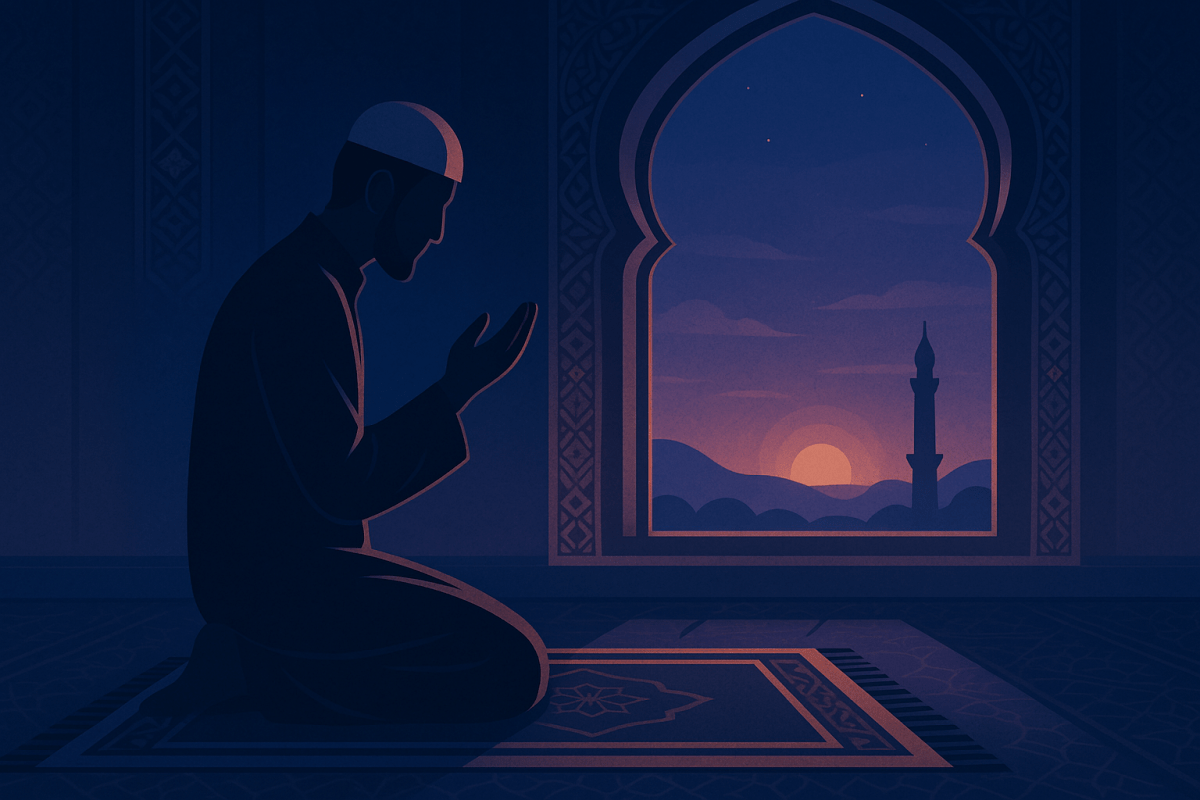
Salat Fajr (صلاة الفجر) represents one of the most precious moments of the Muslim spiritual day. Performed in the quiet of the first light of dawn, it offers a unique opportunity for communion with the Divine - Allah, As-Salâm (The Source of Peace) - before the daily bustle begins. Its regular performance forges remarkable spiritual discipline and brings many benefits both spiritual and practical.
This first prayer of the day takes place at a moment when the world is still peaceful, when the soul is more receptive and when the spirit is clearer. This is why Islamic texts accord it particular importance, designating it as a source of divine protection and a safeguard against daily trials. The dawn prayer is part of the five pillars of Islam, and understanding its method, timing and virtues allows you to fully benefit from it to illuminate each day - Al Hamdulillah.
In Brief
Salat al-Fajr is the first obligatory prayer of the day, consisting of 2 rak'ahs recited aloud. Its time begins at true dawn (الفجر الصادق) and ends at sunrise. The Prophet ﷺ promised that "whoever prays Fajr is under the protection of Allah". This guide covers detailed steps, optional prayers (Sunnah of Fajr), times, tips for waking up, morning invocations to recite after prayer and recommended resources to perfect your practice.

Definition and Importance of Salat al-Fajr
The Fajr prayer holds a central place in daily Islamic worship. The third pillar of Islam, صلاة (Salat, ritual prayer) comprises five obligatory daily prayers, and Fajr is the first, consisting of 2 rak'ahs (units of prayer). It is part of a complete cycle that continues with Salat Dohr at noon, Salat Asr in the afternoon, the Maghrib prayer at sunset, and Salat Icha at night.
The Prophet Muhammad ﷺ emphasized its exceptional importance by declaring: "Whoever prays Fajr is under the protection of Allah" (من صلى الفجر فهو في ذمة الله, reported by Muslim). This spiritual guarantee - this ذمة (dhimma, protection) from Allah - accompanies the believer throughout the day, offering an invisible shield against hardship. We say MashaAllah before such mercy.
According to prophetic tradition, the ملائكة (Mala'ikah, angels) of the night and those of the day meet and witness together this morning prayer, giving it a special cosmic dimension. Allah asks His angels: "How did you leave My servants?", and they respond: "We left them praying, and we found them praying" (al-Bukhari, Muslim). Furthermore, authentic texts indicate that the regular performance of the Fajr and Asr prayers constitutes protection from the fire of Hell - a reminder of the divine attribute Al-Mu'min (the Faithful Protector).
Detailed Guide: How to Perform the Fajr Prayer
Steps of the Obligatory Prayer (2 rak'ahs)
-
Prior Purification (Wudhu, الوضوء) : Ritual ablutions (طهارة, Tahara) are essential before any prayer and must be performed correctly, by washing the hands, face, arms up to the elbows, passing wet hands over the head and feet up to the ankles.
-
Intention (Niyya, النية) : Mentally formulate your intention to perform the dawn prayer for Allah. The intention is placed in the heart without being pronounced aloud.
-
Opening Takbir (تكبيرة الإحرام) : Begin the prayer by pronouncing « الله أكبر - Allahou Akbar » while raising your hands to ear level.
-
First rak'ah :
- Recite the surah Al-Fatiha followed by a surah (such as Al-Ikhlas or Ad-Duha) aloud
- Perform the bowing (Ruku, ركوع) by saying « سبحان ربي العظيم - Soubhana Rabbiyal-Adhim » three times
- Straighten up by saying « سمع الله لمن حمده، ربنا ولك الحمد - Sami'a Allahou liman hamidah, Rabbana wa lakal hamd »
- Perform the prostration (Sujood, سجود) by repeating « سبحان ربي الأعلى - Soubhana Rabbiyal-A'la » three times
-
Second rak'ah :
- Repeat the previous steps with a new surah
- End with the Tashahhud (التشهد, testimony of faith while sitting) including the Abrahamic prayer
- Conclude with the Taslim (التسليم) by turning your head to the right then to the left while saying « السلام عليكم ورحمة الله - Assalamou alaykoum wa rahmatoullah »
Supererogatory prayers recommended before Fajr
In addition to the 2 obligatory rak'ahs, Islam strongly recommends performing 2 supererogatory rak'ahs before Fajr (called Sunnah of Fajr, سنة الفجر). The Prophet ﷺ said about them: « The two [supererogatory] rak'ahs of Fajr are better than the world and all it contains » (reported by Muslim). These prayers are among the most important of voluntary prayers (نوافل, nawafil):
- The recommended recitation includes the Surah Al-Kafiroun in the first rak'ah and Al-Ikhlas in the second
- These supererogatory prayers are short but very meritorious
- The Prophet ﷺ never neglected them, even while traveling - which demonstrates their considerable importance
- They are prayed in a low voice when praying alone, unlike the obligatory prayer
Recommended Books to Learn and Perfect Prayer
To perform Salat al-Fajr with excellence and achieve the خشوع (Khushu', deep concentration), relying on reference works is essential. Here is our selection from the collection dedicated to learning prayer.

The Complete Guide to Prayer (with illustrations)
Sheikh Cherif-Zahar - Al-Haramayn Editions
The most comprehensive and best illustrated guide to master ablutions, the five obligatory prayers (including Fajr) and supererogatory prayers. Each step is explained with clear illustrations - perfect for beginners as well as those who want to verify their practice.
12,90 €
View product
The Summary of the Prophet's Prayer ﷺ - Al-Albânî
The essential reference based on authentic hadiths to learn every gesture of prayer according to the Sunnah, from Takbîr to Taslîm. With clear illustrations, this summary is ideal for perfecting your Salat Fajr and all your daily prayers.
6,00 €
View product
Explanation of the Conditions of Prayer, Its Pillars and Its Obligations
Essential work detailing the conditions of validity (wudhu, qibla, timing), the pillars (arkan) and the obligations (wajibat) of each prayer. Indispensable for understanding what makes your Salat Fajr valid and complete.
8,00 €
View productDeepen concentration in the dawn prayer
The tranquility of dawn naturally favors خشوع (Khushu', concentration). To cultivate this essential quality that gives full meaning to prayer, these works will guide you toward deep focus, reminding you that you stand before Al-Basîr (the All-Seeing) and As-Samî' (the All-Hearing).

Humility and Concentration in Prayer - 33 Tips for Khushû
33 concrete and immediately applicable tips to overcome distractions and develop presence of heart in prayer. Particularly relevant for Fajr, where the serenity of dawn amplifies spiritual connection.
7,00 €
View product
How to Purify Your Soul Through Prayer
Explore the transformative dimension of prayer on the soul. The author shows how each Salat - beginning with Fajr, performed in the serenity of dawn - contributes to inner purification and the spiritual elevation of the believer.
7,90 €
View productPrecise times of Fajr prayer
The dawn prayer has a well-defined time window established by the شريعة (Shari'a):
- Beginning: At true dawn (Fajr al-Sadiq, الفجر الصادق), when a horizontal white line appears on the eastern horizon - not to be confused with false dawn (الفجر الكاذب, al-Fajr al-Kadhib), a vertical light that precedes it
- End: At sunrise (الشروق, al-Shuruq), the moment when prayer becomes forbidden
Examples of prayer times (subject to seasonal variation)
| City | Fajr | Sunrise |
|---|---|---|
| Brussels | 5:25 AM | 7:21 AM |
| Paris | 5:39 AM | 7:14 AM |
Prayer times vary considerably depending on the season and latitude - in summer, Fajr can begin as early as 3 AM in northern France. Use applications like Muslim Pro or consult the months of the Islamic calendar to understand the variations. The optimal time to perform the prayer is at the beginning of its time, in accordance with the Prophetic Sunnah.

Practical Tips for Waking Up for dawn prayer
Getting up for Fajr prayer can be a challenge, particularly in winter when the nights are long. The سلف (Salaf, righteous predecessors) considered regularity at Fajr as a sign of sincerity in faith. Here are some proven tips:
- Adopt a healthy sleep routine: Go to bed early after Icha prayer and avoid bright screens (phones, tablets) at least 30 minutes before sleeping
- Use strategic alarms: Set multiple alarms and place the device far from your bed to force yourself to get up physically
- Recite supplications before sleep: « بسمك اللهم أموت وأحيا - Bismika Allahumma amoutu wa ahya » (O Allah, it is in Your name that I sleep and awake), and the evening remembrances including Al-Ikhlas, Al-Falaq and An-Nas
- Seek the help of a loved one: Ask a family member to wake you up - or organize as a group through a phone call
- Make a sincere intention (نية صادقة): Ask Allah for His help before sleeping - invoke Al-Mujib (The Responder) with confidence, InchAllah
Morning invocations (أذكار الصباح) after Fajr
After performing Salat al-Fajr, the moment is ideal for reciting the أذكار الصباح (adhkar al-sabah, morning invocations). The Prophet ﷺ would not leave his prayer place after Fajr until sunrise, occupying this blessed time with ذكر (dhikr, remembrance of Allah). Among the recommended invocations: the recitation of Al-Ikhlas, Al-Falaq and An-Nâs three times each, Ayat al-Kursi, and the formulas of SubhanAllah, Al Hamdoulilah and Allahou Akbar. The supererogatory prayer of Doha can also be performed later in the morning.

Morning and Evening Dhikr from the Quran and Sunnah
The specialized collection of morning and evening invocations, to be recited after Fajr and after Asr. Includes protective chapters, Ayat al-Kursi, dhikr formulas and daily protection invocations - the ideal companion to your morning routine.
2,50 €
View product
The Fortress of the Muslim (حصن المسلم)
The most popular collection of invocations in the world: morning adhkar after Fajr, evening invocations, invocations for sleep, waking and all occasions. Practical pocket format to keep with you at all times. Also includes invocations after prayer and protective chapters.
3,00 €
View productWhat to do in case of missed Fajr?
Even with the best intentions, it can happen to miss the Fajr prayer. The missed prayer (قضاء, Qada') must be made up as soon as possible, even after sunrise. Do not neglect it on the pretext of having passed its time - the Prophet ﷺ said: "Whoever forgets a prayer or sleeps without performing it, his expiation is to pray it as soon as he remembers it" (al-Bukhari, Muslim).
The make-up method consists of performing the 2 obligatory rak'ahs by following exactly the same steps as the normal prayer. It is also recommended to pray the 2 supererogatory rak'ahs before the obligatory prayer to obtain their merit. Maintain the specific intention of making up the missed prayer and ask forgiveness from Allah - Astaghfirullah. For detailed rules on making up prayers, consult our encyclopedia of fiqh for daily life.
The Fajr prayer: a daily spiritual treasure
The Salat al-Fajr represents far more than a simple religious obligation - it constitutes the foundation upon which the spiritual balance of the entire day rests. By integrating it regularly and consciously, believers cultivate a precious spiritual discipline that radiates across all aspects of their lives. The Quran emphasizes this importance: "Establish prayer at the decline of the sun [from its meridian] until the darkness of the night and [also] the Quran of dawn. Indeed, the recitation of dawn is ever witnessed." (Surah Al-Isra, 17:78).
This morning prayer offers a privileged moment of connection with Ar-Rahmân (the All-Merciful) before worldly preoccupations come to trouble the clarity of the mind. Its regular practice strengthens faith (إيمان, Iman), develops perseverance (صبر, Sabr - recalling the attribute As-Sabûr) and allows one to begin each day under the divine protection promised by the Prophet ﷺ. To deepen your understanding of Islamic spirituality in daily life, the dawn prayer is your most powerful starting point.
During the sacred month of Ramadan, the Fajr prayer takes on even greater importance, as it marks the beginning of the daily fast (صيام, Siyam) after the pre-dawn meal (سحور, Suhoor). The Tarawih and the قيام الليل (Qiyam al-Layl) of the previous night make waking up for Fajr even more meritorious. And during the last ten nights, the quest for Laylat al-Qadr intensifies naturally.

Resources for the whole family
Teaching prayer to children
Transmitting the love of Fajr prayer to children is a spiritual investment for eternity. The Prophet ﷺ taught to order children to pray at the age of seven and to gradually accustom them to it. Adapted educational materials make this learning joyful and memorable. Discover our collection of Islam books for children.

Making our children love prayer
Parental guide offering compassionate methods to transmit the love of prayer - including the challenge of waking up for Fajr. Motivating tips, progressive approach and spiritual rewards to encourage children from age 7.
7,50 €
View product
The Fortress of the little Muslim
Children's version of the Fortress of the Muslim with colorful illustrations. Includes morning invocations after Fajr, those of waking, bedtime and all daily situations of the Muslim child. A first step towards adhkar from the youngest age.
3,45 €
View productUnderstanding the surahs recited during Fajr
To enrich your recitation during Fajr prayer, deepening your understanding of the surahs is essential. Surah Al-Fatiha is the pillar of each rak'ah, while complementary surahs such as Al-Kafiroun, Al-Ikhlas, Al-Kawthar or Yassine (for longer prayers) enrich your worship. Discover our guide to learning the surahs and explore the complete list of the 114 surahs.

Al-Fatiha: Key to the Quran
An in-depth study of surah Al-Fatiha that you recite at least 17 times a day in your prayers. Understanding the meaning of each verse transforms your recitation during Fajr into a genuine dialogue with Allah.
15,00 €
View productFrequently Asked Questions about Salat Fajr
Should one recite aloud or quietly during Fajr?
For the obligatory Fajr prayer, the recitation must be done aloud (جهرية, jahriyya) for both rak'ahs - whether you pray as an imam or alone (although one who prays alone has more flexibility in volume). For supererogatory prayers (Sunnah of Fajr), if you pray alone, the recitation is generally done quietly (سرية, sirriyya).
What is the difference between Fajr and Sobh?
Sobh (صبح) is simply another name for the Fajr prayer. Both terms are used interchangeably in the Muslim world. In certain Maghrebi regions, Sobh more specifically refers to the obligatory 2 rak'ahs prayer, while Fajr encompasses both the 2 supererogatory rak'ahs and the 2 obligatory ones. The essential point is that the obligatory prayer consists of 2 rak'ahs recited aloud.
Which surahs are particularly recommended for Fajr?
For the obligatory prayer: Al-Fatiha (obligatory in each rak'ah) followed by surahs of your choice. The Prophet ﷺ sometimes recited long surahs such as Al-Waqia or Al-Mulk. For the supererogatory prayer: Al-Kafiroun in the first rak'ah and Al-Ikhlas in the second, in accordance with authentic Sunnah.
Can one pray Fajr just before sunrise?
Yes, the Fajr prayer remains valid as long as the sun has not begun to rise. However, it is highly recommended to perform it at the beginning of its time (from true dawn onwards), in accordance with the Sunnah. The Prophet ﷺ prayed Fajr when it was still dark, and women would return home without being recognized because the darkness persisted (al-Bukhari). Delaying Fajr until the last minutes before sunrise is makruh (discouraged) except in case of necessity.
What should I do if I miss the Sunnah of Fajr but arrive in time for the obligatory prayer?
If the إقامة (Iqama, the call to prayer in congregation) has been pronounced, pray the obligatory prayer first. The Prophet ﷺ said: "When the iqama is pronounced, there is no prayer other than the obligatory prayer." You may make up the 2 supererogatory rak'ahs after sunrise, in accordance with the practice reported in authentic hadiths.
Which book do you recommend for learning Fajr prayer?
For beginners, The Complete Guide to Prayer (12.90 €) is the most accessible thanks to its illustrations. For an approach based on authentic hadiths, The Summary of the Prayer of the Prophet by Al-Albânî (6 €) is the reference. For in-depth fiqh, The Book of Prayer (Fiqh as-Salat) (20 €) covers all cases. And do not forget The Remembrance of Morning and Evening (2.50 €) for the adhkar after Fajr.
Key Points to Remember
- The Salat al-Fajr is the first obligatory prayer of the day, composed of 2 rak'ahs recited aloud, preceded by 2 supererogatory rak'ahs (Sunnah) that are strongly recommended.
- Its time begins at true dawn (Fajr al-Sadiq) and ends at sunrise - the optimal moment is the beginning of its time.
- The Prophet ﷺ promised that "whoever prays Fajr is under Allah's protection" throughout the day.
- The angels of night and day witness this prayer, conferring exceptional merit upon it.
- The morning invocations (adhkar al-sabah) are ideally recited after Fajr, remaining in one's place of prayer until sunrise.
- For supererogatory prayers: recite Al-Kafirun then Al-Ikhlas, in accordance with the Sunnah.
- A missed prayer must be made up as soon as possible - there is no sin for one who falls asleep unintentionally.
To deepen your practice of Islamic prayer, explore our collection of works dedicated to Salat, our compilations of invocations, our selection of Qurans, and our prayer mats at the Al-Imen bookstore.
📚 Also Read
−5 % off the entire bookstore with code BLOG5
Valid on the entire site, with no minimum purchase — our thanks to blog readers.
Discover the Selection