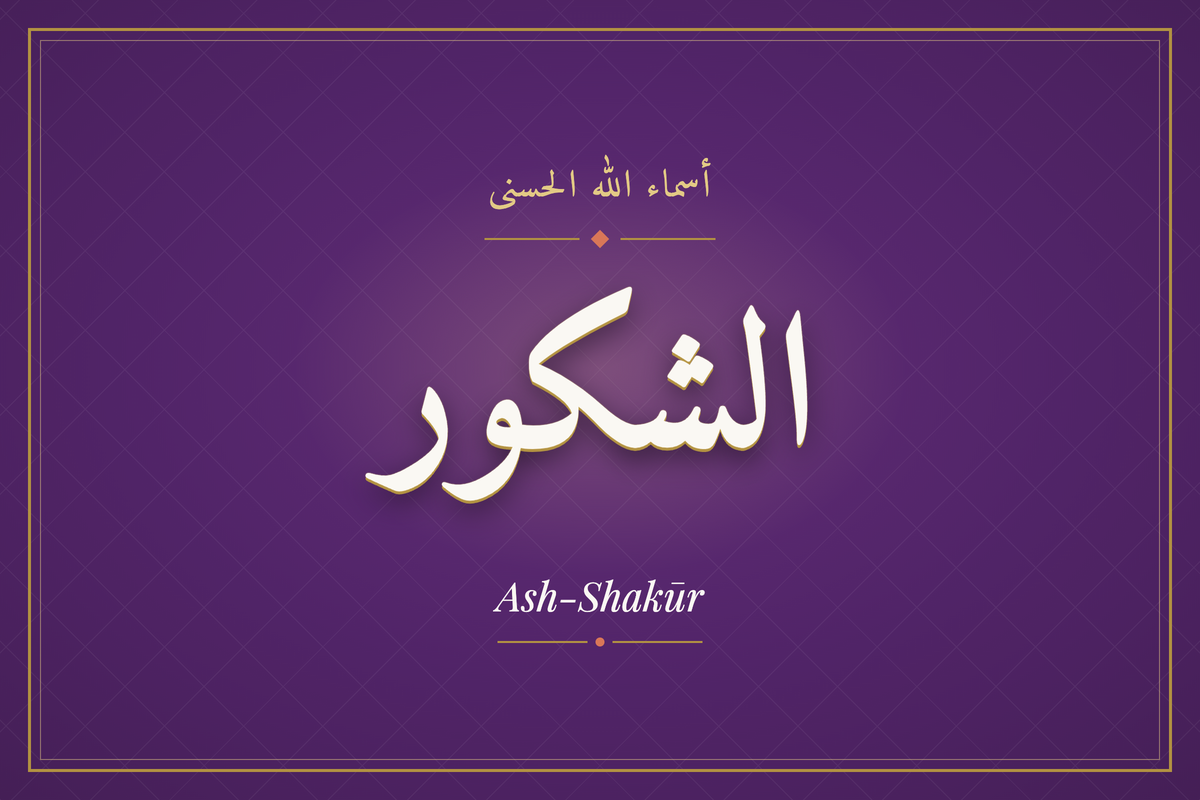
Ash-Shakūr (الشَّكُور), "The Most Grateful," is one of the most astonishing Names of Allah: He Who has need of nothing... thanks His servants. He welcomes the smallest deed, accepts it, multiplies it and rewards it without measure. With Ash-Shakūr, no effort is lost: not a date given, not a step towards the mosque, not a word of good.
What does Ash-Shakūr mean?
The name Ash-Shakūr comes from the Arabic root shīn-kāf-rā' (ش ك ر), which expresses gratitude: the act of responding to good with even greater good. Applied to Allah, this Name designates:
- He who accepts the little: a modest but sincere deed finds with Him an immense welcome.
- He who multiplies the reward: the good deed is multiplied ten times its value, up to seven hundred times and far beyond, bearing no proportion to the effort made.
- He who "thanks" His servants: He mentions their deeds with praise, rewards them eternally for them, and leaves nothing without consequence.
Ash-Shakūr in the Quran
Allah describes the reward of the people of Paradise:
لِيُوَفِّيَهُمْ أُجُورَهُمْ وَيَزِيدَهُم مِّن فَضْلِهِ ۚ إِنَّهُ غَفُورٌ شَكُورٌ
« …so that Allah may give them their full reward and increase it from His grace. He is indeed Forgiving and Most Grateful. » (Surah Fātir, 35:30)
And He says:
إِن تُقْرِضُوا اللَّهَ قَرْضًا حَسَنًا يُضَاعِفْهُ لَكُمْ وَيَغْفِرْ لَكُمْ ۚ وَاللَّهُ شَكُورٌ حَلِيمٌ
« If you lend to Allah a goodly loan, He will multiply it for you and forgive you. Allah is Most Grateful and Most Forbearing. » (Surah At-Taghābun, 64:17)
To give for Allah is to "lend" to the One who always returns more. The Quran also promises: « If you are grateful, I will certainly give you more » (Surah Ibrāhīm, 14:7) — the gratitude of the servant attracts abundance, for it meets the gratitude of Ash-Shakūr.
The Hadith of the Man and the Thirsty Dog
The Prophet ﷺ narrated that a man, having found a dog panting with thirst, descended into a well to fill his shoe with water and gave it to drink. "Allah was pleased with him and forgave him." (Al-Bukhārī and Muslim)
A gesture of a few moments, toward an animal — and divine forgiveness in return. That is Ash-Shakūr: no good deed is too small to be counted.

Living with Ash-Shakūr in Daily Life
1. Do not despise any good action
A smile, a coin given, an obstacle removed from the path: since He who rewards is Ash-Shakūr, there is no such thing as a "small" good deed. The believer sows everywhere, knowing that every seed is counted.
2. Persevere without seeking immediate results
Effort in worship, the education of children, honest work: the fruits are sometimes slow in the eyes of men, never with Allah. Faith in Ash-Shakūr protects from discouragement — nothing done for Him is ever lost.
3. Become grateful yourself
The servant of Ash-Shakūr learns to say thank you: to Allah first, through praise and obedience, then to people — for the Prophet ﷺ said: "He does not thank Allah who does not thank people." (reported by Abū Dāwūd and At-Tirmidhī)
Invocation with the name Ash-Shakūr
The Prophet ﷺ recommended to Mu'ādh ibn Jabal to say after each prayer: اللَّهُمَّ أَعِنِّي عَلَى ذِكْرِكَ وَشُكْرِكَ وَحُسْنِ عِبَادَتِكَ
"O Allah, help me to remember You, to thank You, and to worship You in the best way." (reported by Abū Dāwūd and An-Nasā'ī) — gratitude itself is a help that one asks from Allah.

Frequently Asked Questions about Ash-Shakūr
How can Allah be "grateful" when He needs nothing?
Allah's gratitude is not that of a beneficiary: He draws no profit from our deeds. Ash-Shakūr means that He responds to the little with the immense, that He accepts, mentions with praise and rewards beyond all merit — a "gratitude" of pure generosity.
What is the difference between Ash-Shakūr and Ash-Shākir?
Both forms appear in the Quran. Ash-Shākir affirms that Allah recognizes good; the intensive form Ash-Shakūr expresses its fullness: no deed escapes His recognition, and His reward surpasses all proportion.
How can we thank Allah concretely?
The scholars mention three degrees: gratitude of the heart (recognizing that every blessing comes from Him), that of the tongue (praise, al-hamd) and that of the limbs (using His blessings in His obedience). All of this is summarized in the invocation taught to Mu'ādh.
📚 Continue reading the 99 Names
−5 % off our entire library with code BLOG5
Valid on the entire website, no minimum purchase — our thanks to blog readers.
Discover our books on the Names of Allah